Your customers noticed before you did. The moment they walked in, they felt the stuffy air and almost immediately decided not to come back. Commercial HVAC in Nashville isn’t just about keeping people comfortable, but about keeping them in your building. A struggling AC system costs small businesses in ways that never show up on the repair invoice: lost sales, distracted employees, and a reputation for being that place that’s always too hot.
The good news is that most commercial HVAC problems are preventable. Most small business owners are managing their systems the same way they manage their home unit — reactively, and usually too late. Here’s what proactive commercial HVAC care actually looks like, and why it matters more than most business owners realize.
The Bottom Line Up Front: Quick Hits for Busy Business Owners
- Poor HVAC directly impacts employee productivity and customer experience, not just comfort.
- Commercial systems need professional service more frequently than residential units — at a minimum twice a year.
- Most small-business AC problems show clear warning signs well before a full breakdown.
- A commercial maintenance agreement is almost always cheaper than a single emergency repair call.
- Smart thermostat settings and after-hours scheduling can meaningfully cut your monthly energy bills.
Commercial HVAC Is Not the Same as Residential
A lot of small business owners treat their commercial system like a bigger version of their home AC. It is not. Commercial HVAC systems run longer hours, handle higher occupancy loads, and operate under far more demanding conditions than residential units.
A system that is undersized, undermaintained, or simply worn out does not quietly underperform. It fails publicly, during business hours, in front of customers. C&M’s commercial HVAC services are built specifically for business owners who cannot afford that kind of surprise. The stakes are higher, and the maintenance schedule needs to reflect that.
What Temperature Should an Office Actually Be Set To?
This question comes up more than you’d think, and the answer has real implications for your team’s output. OSHA recommends indoor workplace temperatures stay between 68°F and 76°F for office environments. That range is not arbitrary — research consistently shows that productivity drops sharply outside of it.
A study from Cornell University found that employees made significantly more errors and produced less work in cooler, uncomfortable office environments. In a Nashville summer, keeping your space in the 68 to 76 degree range means your commercial system needs to run efficiently.
Pro Tip: Set your thermostat a degree or two cooler than your target temp during peak afternoon hours in summer. Nashville heat loads peak between 2 pm and 5 pm, and your system will be working hardest right when your staff needs to be sharpest.
How Often Should a Business Have Its HVAC Serviced?
Twice a year at minimum: once in spring before the cooling season and once in fall before the heating season. For businesses with higher foot traffic, commercial kitchens, or systems that run around the clock, quarterly checks are a smarter choice.
This is the area where most small businesses fall short. A residential homeowner might get away with annual service. A business running its system 10 to 12 hours a day, five to seven days a week, cannot.
Explore C&M’s commercial HVAC maintenance options and ask about a service agreement that fits your operation. Predictable costs beat surprise repair bills every single time.
Commercial AC Maintenance Checklist: What Should Actually Be Getting Done
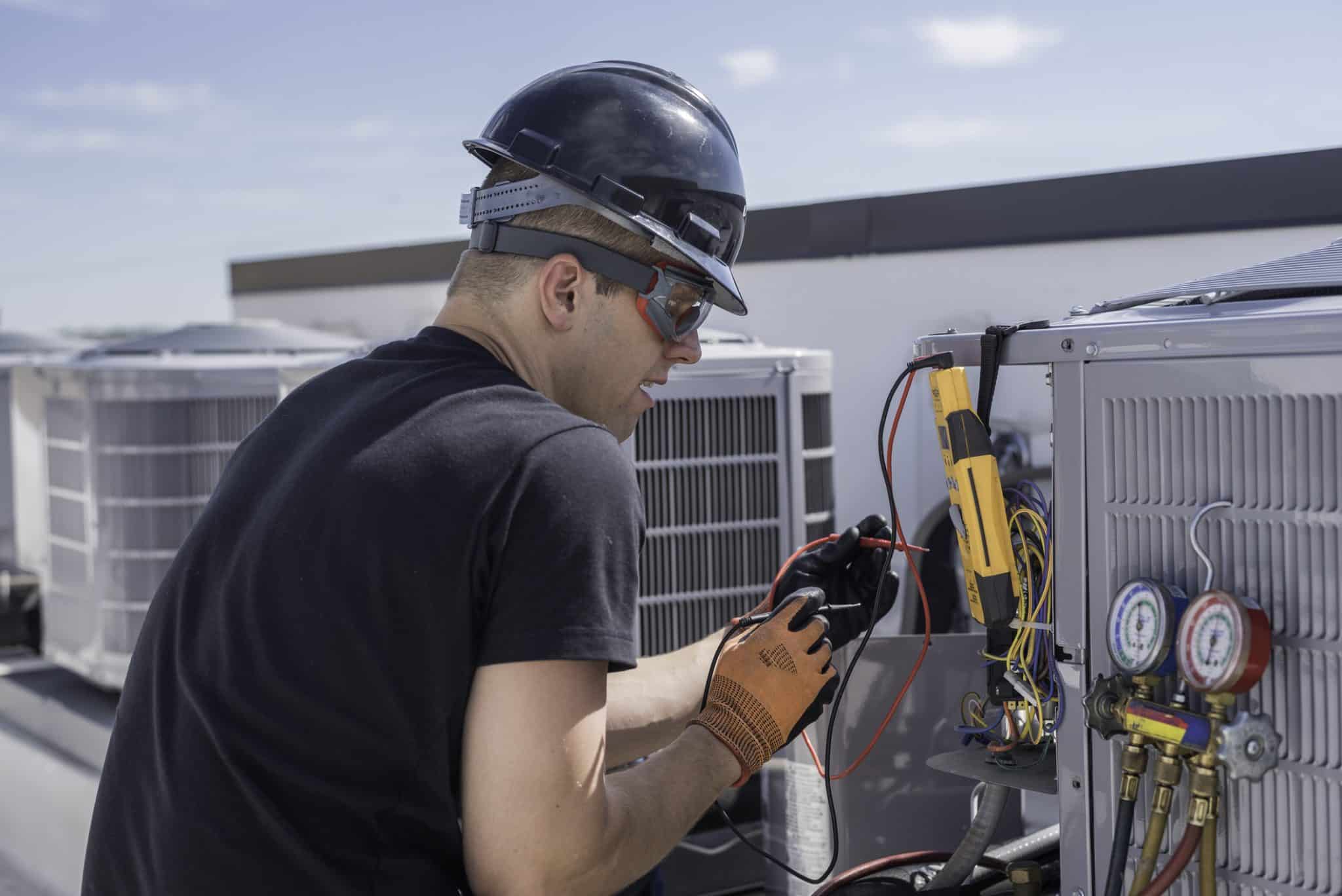
When a technician services your commercial system, here is what a thorough visit should cover:
- Inspect and clean evaporator and condenser coils
- Check refrigerant levels and inspect for leaks
- Test electrical connections and tighten loose components
- Inspect belts, bearings, and motors for wear
- Clear and flush the condensate drain line
- Replace or inspect air filters
- Test thermostat calibration and system controls
- Evaluate airflow and static pressure across the system
- Inspect ductwork for leaks or obstructions
If your current service provider is not covering most of these items, that is worth a conversation. A tune-up that misses half the checklist is not a tune-up.
Signs Your Commercial HVAC Needs Repair Right Now
Waiting for a complete breakdown is the most expensive approach to commercial HVAC. These are the warning signs that mean it is time to call:
- Uneven temperatures across different areas of your space
- The system runs constantly, but cannot keep up during peak afternoon hours
- Unusual noises, like grinding, rattling, or banging during operation
- Energy bills are climbing month over month with no clear explanation
- Frequent short cycling — the system kicks on and off repeatedly
- Humidity levels feel high even when the AC is running
- Staff or customers are regularly complaining about comfort
Any two or three of these together is a call to schedule a commercial AC repair before the system makes the decision for you.
Signs Your Commercial AC May Need to Be Replaced
Sometimes, repair is not the answer. Consider replacing your system if it is over 15 years old, uses the phased-out R-22 refrigerant, has required multiple repairs in the past 2 years, or cannot adequately cool your space even when functioning correctly. Our post on AC repair vs. replacement walks through the decision framework in detail.
How Nashville Small Businesses Can Cut HVAC Energy Costs
Your HVAC system is likely your single largest energy expense. Here is where the savings actually live:
- Program setback schedules: Raise the temperature threshold by 7 to 10 degrees during closed hours — the U.S. Department of Energy estimates this saves up to 10% annually on heating and cooling costs.
- Upgrade to a smart thermostat: Remote access and automated scheduling take the guesswork out of after-hours energy management.
- Seal duct leaks: Commercial duct systems lose a significant amount of conditioned air through leaks, especially in older buildings.
- Change filters on schedule: A clogged filter forces the system to work harder and drives up energy consumption fast.
- Consider zoning: If parts of your space are rarely occupied, a zoned system stops cooling empty rooms on your dime.
Your HVAC System Is a Business Asset — Treat It Like One
A neglected commercial HVAC system is not just an operational headache. It affects your team’s focus, your customers’ experience, and your bottom line every single month it underperforms.
The team at C&M Heating and Cooling has been serving Middle Tennessee businesses since 1976, with commercial HVAC expertise across Nashville, Franklin, Brentwood, and Spring Hill. Proactive maintenance is always cheaper than reactive repair, and a comfortable business is a better business.
Get Commercial HVAC Service for Your Nashville Small Business
If your system is struggling to keep up, your energy bills are climbing, or you simply cannot remember the last time it was serviced, it is time to fix that. C&M works with small businesses across Middle Tennessee to keep their systems running efficiently, reliably, and on budget.
Call us at (615) 790-1362 or contact us online to schedule your commercial HVAC service today.